

How Much Do Polycarbonate Roof Screws Cost? Understanding the Pricing Structure
When purchasing polycarbonate roof screws, one of the first questions is how much the fasteners should cost. However, there is no universal price that applies to every roofing project. The final quotation depends on screw specifications, fastening performance, material selection, order quantity and whether additional installation accessories are required.
Unlike ordinary household screws, polycarbonate roofing screws must accommodate the physical properties of polycarbonate sheets. Roofing panels expand and contract when temperatures change. If screws are installed incorrectly or tightened excessively, the resulting stress may cause cracking, distortion or premature failure around fixing points.
For this reason, roofing fasteners are frequently supplied with sealing washers, rubber gaskets or specially designed fixing accessories. These components help distribute pressure and protect the penetration against rainwater. The appropriate fastening system depends on the specific roofing sheet profile and the manufacturer's installation instructions.
A basic carbon steel roofing screw with a protective coating may have a different purchase cost from a stainless steel screw fitted with a premium EPDM sealing washer. Similarly, a standard self-drilling screw designed for a steel purlin may differ from a timber roofing screw in thread design, drilling capability and installation requirements.
Why Can Polycarbonate Roof Screws Prices Vary So Much?
Price differences generally arise from three areas: manufacturing materials, product specifications and purchasing conditions. Two screws may look almost identical but differ substantially in corrosion resistance, washer quality, manufacturing consistency and compatibility with roofing materials.
A supplier quoting screws only should not be compared directly with another supplier offering complete fastener assemblies with washers, seals and matching accessories. Similarly, a quotation based on several thousand units may carry a different unit price from a small retail package.
The most reliable purchasing approach is to compare the total cost of a compatible fastening system rather than choosing the lowest advertised screw price.
Polycarbonate Roof Screws Cost Breakdown
A comprehensive quotation for polycarbonate roof screws may include more than the screws themselves. Depending on the project, suppliers may charge separately for sealing washers, accessories, packaging, delivery and installation services.
| Cost Item | Description | Reasons for Price Differences |
|---|---|---|
| Screw Material | Base material used to manufacture the roofing fastener. | Carbon steel, stainless steel grades and protective coatings have different manufacturing costs. |
| Screw Dimensions | Overall length, diameter, thread configuration and head dimensions. | Longer or specialized screws require different material quantities and production processes. |
| Sealing Washers | EPDM gaskets, metal-backed washers or profile-specific seals. | Washer diameter, rubber quality and sealing design influence total cost. |
| Surface Treatment | Protective finishes that improve resistance to environmental corrosion. | Coating specifications, thickness and tested performance vary. |
| Fixing Accessories | Spacers, profile supports, caps and compatible fastening components. | Different roofing systems require different accessory combinations. |
| Packaging Quantity | Quantity of fasteners supplied per box, carton or bulk order. | Small retail quantities and wholesale orders may have different unit costs. |
| Installation Labour | Labour required for positioning, drilling and fastening roof sheets. | Roof accessibility, complexity, height and fixing density affect labour time. |
| Freight and Delivery | Transportation from supplier or manufacturer to the project location. | Delivery distance, shipment weight, urgency and location affect freight charges. |
| Quality Documentation | Product specifications, coating information and applicable test documentation. | Additional verification, traceability and project documentation may increase procurement costs. |
This breakdown helps buyers understand why quotations from different suppliers may not be directly comparable. A slightly higher-priced fastener may offer better corrosion resistance or include a washer that is not provided with the cheaper alternative.
Should You Compare Price Per Screw or Price Per Roofing Project?
For smaller projects, comparing the price per screw can be useful. However, large installations benefit from evaluating the total fastening cost, including required quantities, spare fasteners, accessories, delivery and labour.
For example, purchasing cheaper screws that require separately sourced washers may increase procurement complexity. Conversely, a more expensive specialized fastener could reduce certain installation steps if its use is approved by the roofing sheet manufacturer.
The best option depends on compatibility, installation requirements and total project cost rather than unit price alone.
9 Factors Affecting Polycarbonate Roof Screws Prices
Understanding the following nine factors helps buyers estimate procurement requirements, compare supplier quotations and avoid purchasing unsuitable roofing fasteners.
- Screw Material: Carbon steel screws with protective coatings are commonly used in many roofing applications, while stainless steel options may be considered for environments where increased corrosion resistance is required. Material grades and product specifications affect cost.
- Screw Length and Diameter: Fastener dimensions must be selected according to roofing sheet profile, support thickness and required penetration. Longer or larger-diameter screws may carry higher manufacturing costs.
- Washer Type and Quality: Roofing fasteners often require sealing washers suitable for outdoor exposure. EPDM washers with metal backing can provide effective sealing when correctly specified and installed.
- Roofing Sheet Profile: Corrugated, trapezoidal and multiwall polycarbonate sheets may require different fastening arrangements. Accessories must match the relevant roof sheet system.
- Supporting Structure: Timber and steel purlins require appropriately designed screws. Thread geometry and drilling features differ according to the supporting material.
- Corrosion Resistance: Roofs exposed to salt air, humidity or industrial environments may require enhanced corrosion protection. Environmental exposure can influence fastener specifications and cost.
- Order Quantity: Wholesale purchases may provide more favourable unit pricing than small orders. However, minimum order quantities and packaging requirements should also be considered.
- Product Certification and Quality Control: Fasteners supplied with documented specifications, traceable manufacturing information or relevant performance testing may have different pricing structures.
- Delivery and Availability: Standard inventory, special-order products and urgent deliveries may carry different freight costs and lead times.
Does Screw Material Really Make a Difference?
Yes. Roofing fasteners remain exposed to changing temperatures, moisture and atmospheric conditions throughout their service life. Corrosion can reduce the reliability of a fixing and may eventually create maintenance problems.
Stainless steel and appropriately coated steel fasteners offer different combinations of mechanical performance, corrosion resistance and purchase cost. The correct selection should consider environmental exposure, structural requirements, supplier specifications and compatibility with adjacent materials.
Why Are Sealing Washers Important?
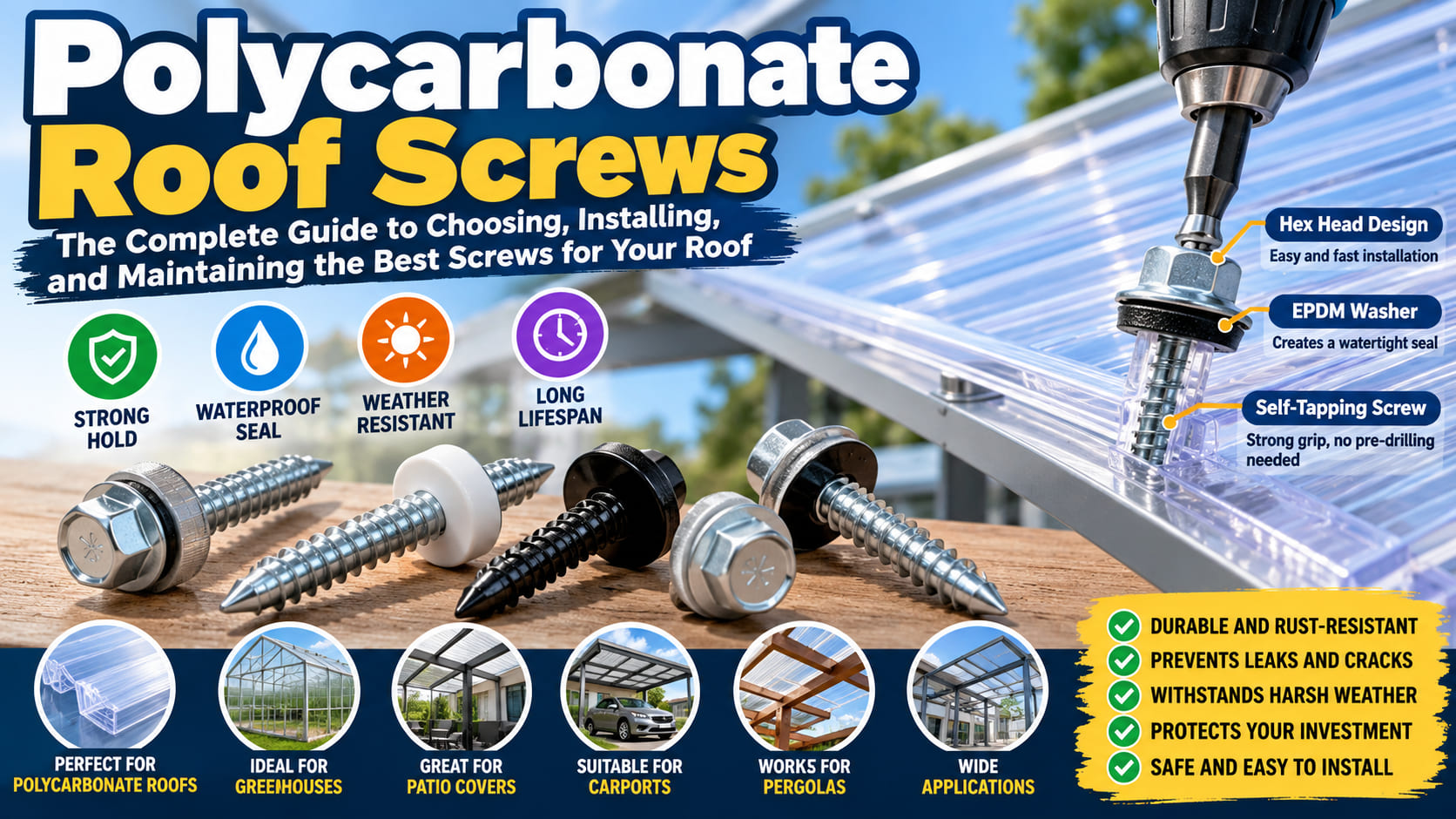
The washer is a critical part of the fastening system. A suitable gasket helps seal the penetration while distributing fastening pressure over the roofing sheet. This is particularly important because polycarbonate responds to temperature changes through expansion and contraction.
Poor-quality or incompatible washers may deteriorate, deform or fail to seal correctly. However, washer quality alone cannot compensate for incorrect hole sizes, poor fastener positioning or excessive tightening.
3 Budget Options: Economy, Balanced and Premium
Economy Option: Prioritising Essential Fastening Requirements
An economy option is suitable for budget-conscious buyers working on straightforward roofing installations in environments without unusual corrosion exposure. The objective should be to purchase compatible, properly specified roofing screws without paying for unnecessary features.
Coated carbon steel screws may be appropriate where permitted by the roofing manufacturer's instructions and local exposure conditions. Buyers should still confirm the required corrosion rating, washer specifications, thread type and screw dimensions.
Reducing costs should never involve omitting required sealing washers or choosing undersized fasteners. A low initial purchase price may be outweighed by future repair costs if the fastening system is unsuitable.
Balanced Option: Combining Cost, Durability and Installation Reliability
A balanced purchasing strategy generally focuses on established roofing fastener specifications, dependable sealing washers and appropriate corrosion protection. This approach is often practical for residential patios, carports, pergolas and other routine roofing installations.
Rather than choosing screws solely by price, buyers can compare product specifications, supplier documentation, packaging quantities and recommended installation methods. Purchasing fasteners and matching accessories from the same supplier may also simplify compatibility checks.
This option aims to balance upfront spending with long-term reliability and manageable maintenance requirements.
Premium Option: Enhanced Specifications for Demanding Environments
Premium fastening systems may be appropriate for large commercial buildings, coastal properties, industrial facilities or projects requiring particular product specifications and documentation.
Depending on engineering requirements, these projects may call for stainless steel fasteners, high-performance protective coatings, specialized sealing systems or documented corrosion testing.
Although the initial polycarbonate roof screws price may be higher, the purchasing decision should reflect the expected service conditions and the financial consequences of maintenance, replacement or premature failure.
8 Questions to Ask Before Accepting a Polycarbonate Roof Screws Quotation
A quotation should provide enough information to verify that the proposed fasteners match the roofing application. Before placing an order, ask the supplier the following questions.
- What material and grade are the screws made from? Confirm whether the fasteners are coated carbon steel, stainless steel or another specified material.
- Are sealing washers included? Check whether the quotation includes EPDM gaskets, metal-backed washers or other required accessories.
- What are the exact screw dimensions? Verify diameter, length, thread type, head design and recommended penetration.
- Are the screws compatible with my roof sheets? Specify the roofing brand, sheet profile and support material to verify the proposed fastening system.
- Are there any additional charges? Ask about packaging, freight, taxes, accessories, special orders and minimum quantities.
- What corrosion protection is provided? Request relevant coating information or material specifications suitable for the installation environment.
- What is the delivery lead time? Confirm stock availability, dispatch dates and potential delays for custom or high-volume orders.
- What are the payment and return conditions? Clarify deposits, payment terms, incorrect-product claims and returns before placing the order.
These questions help buyers compare suppliers on consistent specifications rather than relying on incomplete price lists. They are particularly useful when requesting quotations from multiple manufacturers or distributors.
Common Pricing Mistakes and Installation Risks
Choosing the Cheapest Screws Without Checking Compatibility
One of the most common purchasing mistakes is selecting roofing screws based solely on price. Ordinary fasteners may lack the appropriate sealing components, drilling features or corrosion protection required for polycarbonate roofing systems.
Buyers should confirm that the fasteners are suitable for the specific sheet manufacturer, roofing profile and supporting structure. Substituting a cheaper screw without verifying compatibility can create problems that cost more than the initial saving.
Ignoring Thermal Expansion Requirements
Polycarbonate roofing sheets expand when heated and contract as temperatures fall. Many systems therefore require oversized fixing holes or proprietary fastening components designed to accommodate thermal movement.
The required hole diameter varies between roofing systems. For example, some manufacturer instructions specify clearance holes larger than the screw shank, while other proprietary systems provide alternative drilling arrangements. Always follow the relevant sheet manufacturer's installation instructions rather than applying one hole size to every product.
Overtightening Polycarbonate Roofing Screws
Excessive tightening can compress washers incorrectly and create unwanted stress around the fixing holes. This may contribute to cracking, sheet distortion or leakage.
A suitable screw-driving tool with controlled torque can help achieve consistent installation. The screw should be tightened according to the manufacturer's instructions, allowing the washer to seal without unnecessarily restricting thermal movement.
Using the Wrong Screws for Timber or Metal Supports
Timber and metal supporting structures do not necessarily use the same fastening design. Self-drilling roofing screws may be specified for suitable metal purlins, while timber screws require an appropriate thread configuration and penetration depth.
Choosing a screw that is too short or incorrectly designed may reduce fixing performance. Always confirm substrate compatibility and required fastening dimensions before ordering.
Overlooking Washer Durability and Corrosion Exposure
Roofing fasteners are exposed to moisture, sunlight and changing weather conditions. A screw may remain mechanically intact while a poor-quality washer deteriorates and compromises sealing.
Fastener assemblies should therefore be evaluated as complete products, including screw material, washer performance and suitability for the surrounding environment.
How to Prepare for an Accurate Polycarbonate Roof Screws Quotation
Preparing accurate specifications before contacting a supplier can reduce quotation delays and help prevent ordering errors. Buyers do not necessarily need to know every technical detail, but providing the correct roofing information makes product selection much easier.
Information to Prepare Before Requesting a Quote
- Roofing sheet manufacturer and product model.
- Polycarbonate sheet type, thickness and profile.
- Supporting structure material, such as timber or steel.
- Required screw diameter, length and head configuration, if known.
- Required sealing washer or compatible fixing accessories.
- Estimated quantity based on the approved fixing pattern.
- Environmental conditions, including potential coastal or industrial exposure.
- Delivery destination and preferred delivery date.
- Any project-specific documentation, material or performance requirements.
How Many Polycarbonate Roofing Screws Will You Need?
The required screw quantity depends on roof dimensions, sheet profile, supporting structure spacing, wind exposure and the fastening pattern specified by the roofing manufacturer.
Different roof zones may require different fixing densities. Areas near edges and corners can experience higher wind uplift forces, so the fastening arrangement should follow the applicable engineering and manufacturer requirements.
Instead of estimating a universal number of screws per square metre, determine the required quantity using the approved fixing layout. Buyers may also consider an appropriate allowance for spare fasteners to cover installation waste or replacements.
Why Is the Roofing Manufacturer's Installation Guide Important?
Polycarbonate sheet manufacturers may specify particular fastener dimensions, hole clearances, washer types, fixing locations and installation procedures. These details help the roofing system accommodate temperature movement and maintain appropriate weather resistance.
For example, Palram's SUNTUF technical information recommends corrosion-resistant fasteners and suitable EPDM sealing washers, with fastening methods selected according to the support material and roofing profile. Such guidance should be checked against the exact sheet product being installed.
Polycarbonate Roof Screws FAQ
Q1: How much do polycarbonate roof screws cost?
Polycarbonate roof screws prices depend on material, dimensions, washer design, corrosion resistance and order quantity. The most reliable comparison is based on identical product specifications and total delivered cost rather than unit price alone.
Q2: Are there any hidden costs when purchasing polycarbonate roofing screws?
Additional costs may include sealing washers, special accessories, freight, taxes, minimum order quantities or installation labour. Buyers should request a detailed quotation showing what is included and which charges are separate.
Q3: How long does delivery usually take?
Delivery time depends on supplier inventory, order quantity, location and whether the screws are standard or special-order products. Buyers should confirm stock availability and the expected dispatch date before placing an order.
Q4: What payment methods are available for bulk orders?
Payment arrangements vary by supplier. Common options may include bank transfer, card payment, advance payment or approved business credit terms. Confirm payment conditions, currency and applicable taxes when requesting a quotation.
Q5: Do polycarbonate roof screws need rubber washers?
Many polycarbonate roofing systems require suitable sealing washers, commonly using EPDM gaskets with metal backing. The exact washer type and size should match the roofing manufacturer's specifications to provide appropriate sealing and fastening performance.
Q6: Can ordinary metal roofing screws be used on polycarbonate sheets?
Ordinary metal roofing screws should not automatically be assumed suitable. Polycarbonate sheets require fastening arrangements that accommodate thermal expansion and provide compatible sealing. Always verify screw, washer and drilling requirements with the sheet manufacturer.
Q7: Should polycarbonate roofing sheets be pre-drilled before installing screws?
Many polycarbonate roofing systems require oversized pre-drilled holes to accommodate thermal movement. Some proprietary fastening systems have different procedures. The correct drilling method and hole size must follow the specific roofing manufacturer's installation instructions.
Q8: Are stainless steel screws better for polycarbonate roofing?
Stainless steel screws may offer corrosion-resistance advantages in suitable applications, but the correct fastener depends on material grade, environmental exposure, structural requirements and compatibility with the roofing system. Stainless steel is not automatically necessary for every project.
Q9: How many screws are needed for a polycarbonate roof?
The required quantity depends on roof dimensions, sheet profile, purlin spacing, wind exposure and the manufacturer's fastening pattern. Use the approved roof fixing layout rather than a universal screws-per-square-metre estimate.
Q10: How can I request an accurate quotation for polycarbonate roof screws?
Provide the roofing sheet type, manufacturer, profile, supporting structure, required fastener specifications, estimated quantity and delivery destination. Clear information allows suppliers to recommend compatible products and prepare more accurate quotations.